Nitric Oxide Explained: The Molecule Behind Half the Supplement Aisle
The gist
- Nitric oxide is a signalling gas that tells blood vessels to relax and widen.
- The endothelium becomes less efficient at producing it with age and vascular damage.
- There are two production routes: the enzymatic pathway and the dietary nitrate pathway.
- Leafy greens and beetroot feed the second route and cost almost nothing.
What nitric oxide actually is
It is a gas. Not a nutrient, not a hormone, not something you can swallow directly — a short-lived signalling molecule made inside your blood vessels and consumed within seconds of being produced.
That last detail explains a great deal about supplement marketing in this category. Because nitric oxide cannot be bottled, everything sold under its name is really selling a precursor: something the body can convert into it. Whether a given precursor does that efficiently is the whole question.
Its discovery as a biological signalling molecule was significant enough to earn a Nobel Prize in Physiology or Medicine in 1998, which is a reasonable indication this is real science rather than marketing invention. What gets built on top of that science is where things get looser.
Its job in the body
Your blood vessels are not passive tubes. They have a layer of smooth muscle in the wall that contracts and relaxes, changing the vessel's diameter and therefore how much blood flows through it.
Nitric oxide is one of the primary signals telling that muscle to relax. Produced by the endothelium — the single-cell-thick lining on the inside of every vessel — it diffuses into the surrounding muscle and triggers relaxation. The vessel widens. Flow increases.
This is called vasodilation, and it happens constantly and automatically. When you climb stairs, vessels feeding your leg muscles widen to deliver more oxygen. That responsiveness is what "healthy circulation" describes in practical terms.
Why production changes with age
Endothelial function tends to decline gradually with age, and the capacity to produce nitric oxide declines with it. That much is well documented.
What accelerates it is more useful to know, because it is largely modifiable. High blood pressure damages the endothelium mechanically. Elevated blood sugar damages it chemically. Smoking does both. Oxidative stress degrades nitric oxide after production, meaning less of it survives to do its job.
The reverse also holds. Regular aerobic exercise is the most reliably documented way to improve endothelial function — the mechanical stress of increased blood flow appears to stimulate the very machinery that produces nitric oxide. This is one of the clearest cases in physiology of a system that improves with use.
Two routes, not one
Here is the part supplement pages routinely omit. There are two separate pathways producing nitric oxide, and they work through entirely different mechanisms.
The enzymatic pathway. An enzyme called nitric oxide synthase converts the amino acid L-arginine into nitric oxide. This is the pathway everything marketed as a "nitric oxide booster" targets, and it requires oxygen to function.
The nitrate–nitrite–NO pathway. Dietary nitrate from vegetables is reduced to nitrite by bacteria in your mouth, then to nitric oxide in the body. It works independently of the enzymatic route and actually functions better in low-oxygen conditions — exactly the situation in hard-working muscle.
Most men chasing this are aware only of the first route, and it is the more expensive one to influence.
Where L-citrulline fits
If the enzymatic pathway runs on arginine, the obvious move is to take arginine. That was the first generation of these products, and it turned out to work poorly.
The reason is a metabolic bottleneck. Oral arginine is extensively broken down by an enzyme in the gut wall and liver before reaching general circulation. A substantial proportion never arrives where it is needed.
L-citrulline takes a different door. It is absorbed largely intact, travels to the kidneys, and is converted to arginine there — downstream of the bottleneck. This is why citrulline has largely displaced arginine in circulation-focused formulations, and it is a genuinely sound piece of formulation logic rather than a marketing story.
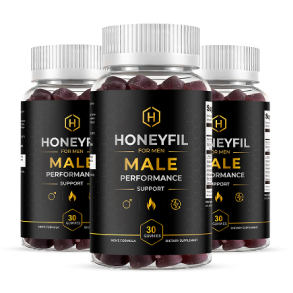
Citrulline is one of the eight disclosed ingredients in the HoneyFil formula, paired with pine bark extract on the circulation side. Two honest caveats apply, as they do to any product in this space: research on isolated citrulline at defined doses does not automatically describe a combination gummy, and the amount present is what determines whether the inclusion is meaningful. That figure lives on the Supplement Facts panel, not on a website.
The food route almost nobody uses
Given that the dietary nitrate pathway exists, is well supported and costs the price of vegetables, it is odd how rarely it comes up.
The richest sources are leafy greens — rocket, spinach, lettuce — and beetroot. Beetroot juice in particular has been studied extensively in exercise physiology for its effects on blood flow and oxygen efficiency during activity.
One practical warning that surprises people: strong antibacterial mouthwash can blunt this pathway. The first conversion step depends on bacteria living on your tongue. Eliminate them and you interrupt the chain. If you are eating nitrate-rich vegetables specifically for this reason, aggressive mouthwash works against you.
What it will not do
Time for the necessary corrective. Nitric oxide is a real mechanism with real relevance to circulation. It is not a solution to a medical problem.
If you are experiencing persistent changes in circulation or sexual function, the appropriate response is a healthcare professional, not a precursor supplement. Those changes can signal cardiovascular disease, diabetes, hormonal conditions or medication effects — none of which a gummy addresses, and all of which benefit enormously from being caught early.
There is also a specific interaction worth flagging. Nitrate medications prescribed for chest pain act on this same pathway. If you take nitrates, blood-pressure medication or blood thinners, speak to your doctor before adding anything targeting nitric oxide.
Where a supplement fits is at the margins of a routine that already includes movement, sleep and reasonable food. That is the framing behind HoneyFil's approach — nutritional and botanical support alongside the fundamentals rather than instead of them. Our full verdict on the product covers where that holds up and where it does not.
Nutritional support, once a day
HoneyFil combines eight disclosed ingredients into a single daily gummy, formulated to support energy, healthy circulation, stamina and endurance. One-time purchase, no auto-renewal, 60-Day Satisfaction Promise.
Individual results vary.
Try HoneyFil →Common questions
Can you take nitric oxide directly as a supplement?
No. Nitric oxide is a short-lived gas produced and consumed within the body in seconds. Products marketed for it supply precursors the body can convert, such as L-citrulline.
Why is L-citrulline used instead of L-arginine?
Oral arginine is largely broken down in the gut wall and liver before reaching circulation. Citrulline is absorbed more intact and converted to arginine downstream of that bottleneck.
What raises nitric oxide besides supplements?
Regular aerobic exercise is the most reliably documented approach. Dietary nitrate from leafy greens and beetroot feeds a second, separate production pathway.
Is it safe with blood pressure medication?
Speak with a healthcare professional first. Nitrate medications and blood-pressure medications act on related pathways, so the combination warrants medical input.
Before you start
HoneyFil is a dietary supplement intended to complement a healthy lifestyle. It is not a prescription product, and it is not intended to treat erectile dysfunction or any other medical condition.
It is not for anyone under 18, and not intended for women or anyone pregnant or breastfeeding. Speak with a healthcare professional first if you take prescription medication — particularly blood-pressure medication, nitrates, blood thinners or diabetes medication — manage a medical condition, or are preparing for a procedure.
If you have persistent concerns about sexual function, energy or circulation, raise them with a qualified healthcare professional rather than relying on a supplement.
These statements have not been evaluated by the Food and Drug Administration. This product is not intended to diagnose, treat, cure, or prevent any disease.
Back to the Honey-Fill homepage, or take a look at what goes into the formula and our honest verdict on it.